Agentic File Systems
Author: Jason Rubenstein
“Every 10 years someone comes around and says, oh, the file system is dead. The way in which it's so fundamental to how you program, how you run programs. It's never going to go away." - Andres Rodriguez (Nasuni Founder)
Agents handle files well because their training data is dense with file operations from large public codebases. That is turning file systems into an interface agents use to store context, navigate their work, and produce outputs. Agents do not know in advance how their output should be organized. File systems let them write freely and retrieve what they need through semantic search.
But the file system agents use today was built for humans and the programs they run, not for autonomous software making frequent, large-scale changes in parallel with other agents and humans. As agentic use scales, four gaps in current file systems create an infrastructure opportunity.
Why now
A single agent working alone needs no shared, live file system. The shift to multi-agent systems, where an orchestrator coordinates sub-agents, changes that. When several agents write to a shared state at once they collide, producing results that are hard to trace. The fix is moving the file system off a single, constrained machine and onto a shared layer where many agents and people write to the same state.
The four things ordinary file systems get wrong for agents
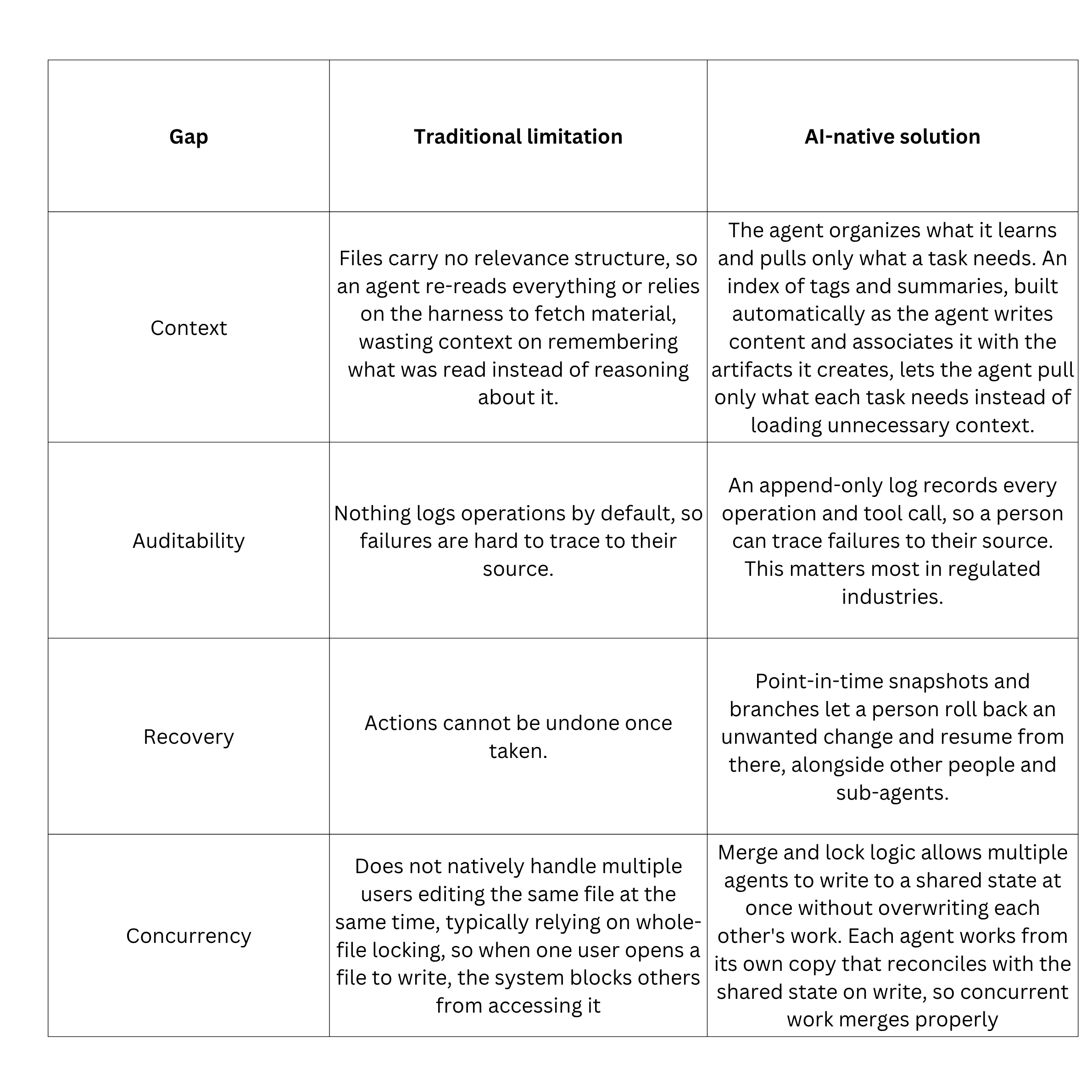
Where will value accrue
Cloud storage and databases owned by hyperscalers compete on scale and reliability that startups cannot undercut. The new opportunity for file systems is to sit directly above that layer, serving as the primary interface for agents. Their moat is the governance layer, tailored to each customer vertical.
Writing directly to cloud storage and databases also requires more specific information, including passwords, paths, schemas, and data structures, than an open file system. As a result, file system interfaces let agents complete tasks through the mechanisms best suited to each one.
This is also why we do not expect a single winner. Value compounds within each customer, locking them in, but it does not naturally attract the next customer, making the network effects that create dominant winners relatively weak. Instead, what compounds is the reasoning and history a system builds for each customer, and that accumulation is inherently vertical specific. This does not mean the market fragments completely. Storage and file system interfaces trend toward shared, horizontal layers because they contain little that is different across industries. The defensibility sits in the governance layer above them, where the audit trail and permission models required by legal, healthcare, financial services, research, and robotics all differ. At the same time, a file system company that moves quickly can expand across multiple verticals by integrating governance protocols tailored to industry standards. This is already visible with Mesa.dev, whose file system has early pilot partners in legal, healthcare, in addition to coding agents.
Developer experience and agent ergonomics matter here. In developer tools, small interface choices often decide who wins, because they compound into different day-to-day experiences. The same holds for systems built for agents, where speed is a highlighted feature such as Mesa’s file system having 50ms to first read. How a file system exposes information, errors, and version history will shape adoption. Another key factor is who captures developer (and agentic developers) mindshare first. As companies like LangChain showed, gaining a first-mover advantage matters and gives you the ability to offer new features and products over time.
Where founders can build
We see an opportunity to build a horizontal file system engine and interface with a vertical governance layer on top. A team can win by building that governance layer around an industry’s way of working, then running the same engine underneath others. A few openings stand out.
Legal: Track document changes and who made them, control access by matter and confidentiality level, and keep every version unaltered.
Healthcare: Track who viewed a record, not just who edited it, since privacy law refers to who looked at patient data as well as who changed it. Also, strip identifying personal details wherever needed.
Financial services: Keep historical records unchanged, and reconstruct what the data showed on any past date. Regulators must be able to trace all changes.
Research: Let researchers branch in many directions and merge back what works. Bundle the data, code, setup, and settings so a result can be reproduced after iteration.
Robotics and field operations. Run on the device, stay responsive even when offline, and re-sync without conflicts once the connection returns.
The real value might sit up the stack, captured by application-layer companies that build a specialized file system in-house rather than buy one. I believe this, while plausible, is unlikely as application layer companies are poorly suited to spend engineering time and capital maintaining file system infrastructure outside its core product. Cloud, database, and dev tools platforms sit closer to that infrastructure already and have a stronger incentive to own it than an application-layer company has to build it.
Regulated verticals face the least competition because a file system can become the system of record that other systems integrate with. When a workflow owner decides that owning its file system distracts from its core product, a standalone player has room to win. Winning teams commit to one vertical with real governance requirements, accumulate per-customer context that compounds, tie an agent’s reasoning to its outputs in the same versioned path, and stay agnostic about the underlying storage.
If you're a developer platform adding agent-native file systems to your offering, an application-layer company already deploying file systems to users, or a founder building the agent file system interface itself, please reach out. We’d be excited to hear from you!